

If your lower denture slips, rocks, or makes you nervous every time you eat or talk, just two dental implants may be enough to fix that. A two-implant overdenture is one of the most well-supported options in restorative dentistry for stabilizing a lower denture. For many people, it hits the sweet spot between cost, comfort, and results.
At Atlas Dental Specialists, we work with patients across Pittsburgh every day who are somewhere along the denture spectrum. Not everyone needs a fully fixed set of teeth, and not everyone wants to go back to a denture that shifts around. Our implant-supported dentures approach is built around finding the right fit for where you are, and two implants on the lower jaw are often exactly that.
What Is a Two-Implant Overdenture?
A two-implant overdenture is a removable lower denture that snaps onto two implants placed in the front of your jaw. The implants act like anchors, holding the denture securely in place so it doesn’t slide or lift when you chew. You still take the denture out to clean it, but when it’s in, it stays put.
This is different from a full all-on-4 fixed restoration, where the teeth are permanently attached and never come out. It’s also different from a conventional denture that rests directly on your gums with no implant support. Bridging the gap between two extremes, the two-implant overdenture provides the stability that conventional dentures lack while remaining removable for straightforward maintenance.
Why the Lower Jaw Is Different
Upper dentures usually have a little more working in their favor. The upper jaw has more surface area, which helps create better suction and support. Lower dentures are different. There is less surface area to work with, the tongue is constantly moving around them, and the ridge where the denture sits can shrink over time as bone loss progresses.
That is why lower dentures tend to feel more frustrating for many patients. Two implants can make a big difference because they provide the denture with stable points to snap onto, rather than relying on suction alone.
What the Research Says
A systematic review published in the Journal of Clinical Medicine found strong support for using a two-implant overdenture as the preferred treatment for the lower jaw with no remaining teeth, rather than a traditional denture. That kind of agreement is worth noting, especially in dentistry, where treatment recommendations can vary from case to case.
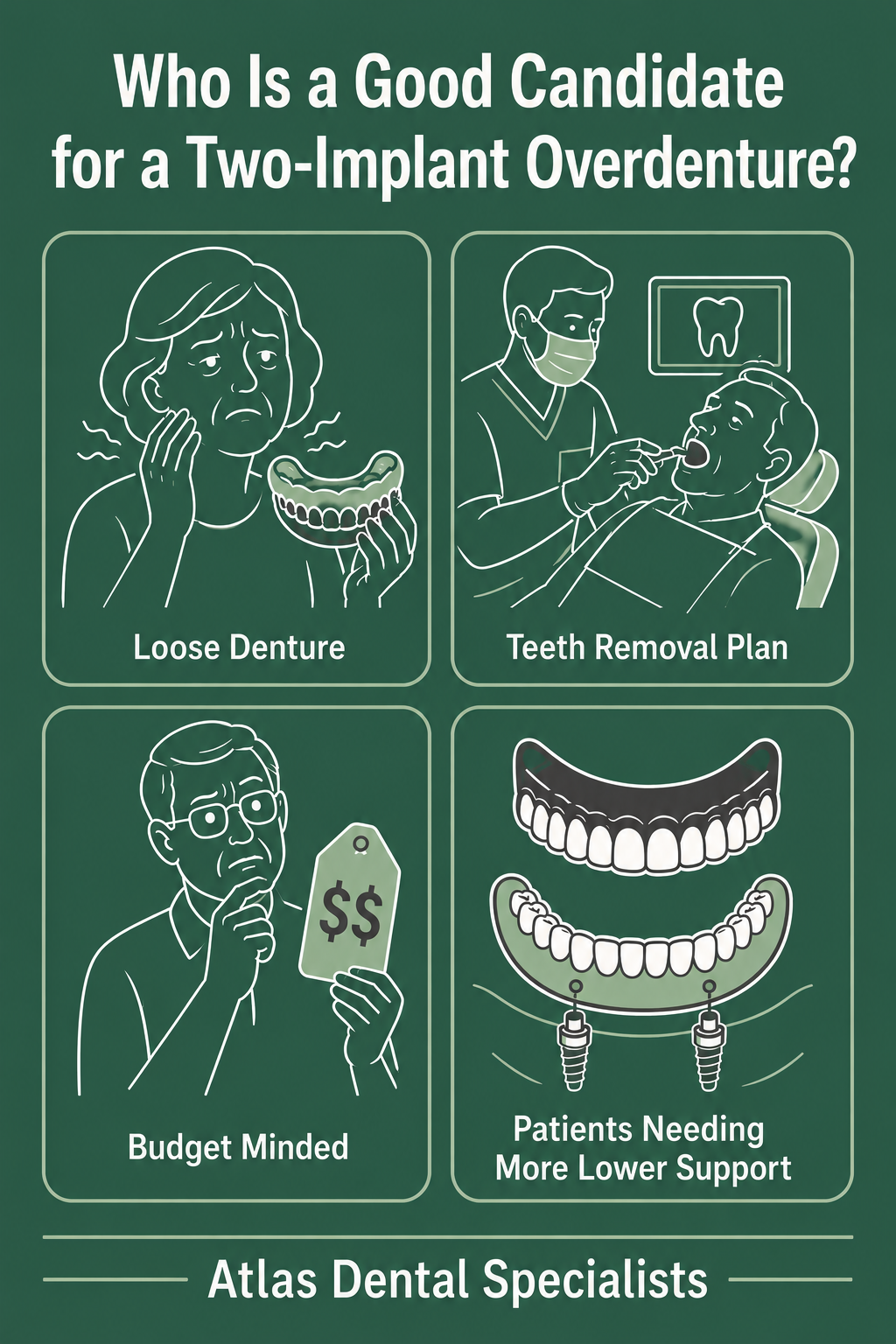
Who Is a Good Candidate?
Two-implant overdentures are a strong option for a wide range of patients. Here are the situations where we most commonly recommend this approach:
- Current denture wearers who are frustrated with fit: If you’ve had your denture adjusted multiple times and it still moves around, implants may be able to solve the problem for good.
- Patients who need extractions: If you’re heading toward full tooth loss in the lower jaw, planning for implants at the same time as extractions is a smart approach.
- People who want stability without a large investment: Two implants cost significantly less than a full fixed restoration, but they deliver a meaningful improvement over a floating denture.
- Patients already happy with a conventional denture on top: We’ve had patients go with implant support on the bottom and a conventional denture on top, find they love the result, and come back later to add implants on the upper arch too.
The right starting point depends on your bone density, your health history, and what you’re hoping to accomplish. A consultation gives us the full picture.
What to Expect from the Process
Most patients are surprised by how manageable the process feels. It usually starts with a straightforward appointment to place the two implants, followed by a healing period while the implants bond with the jawbone. Once the area has healed, the denture is fitted with small attachments that snap securely onto the implants. From start to finish, the process typically takes a few months.
Caring for the denture is simple, too. You remove it to clean it, just like you would with a traditional denture. The small attachment pieces inside the denture may need to be replaced from time to time, but everyday maintenance is pretty straightforward. If you already wear a snap-in denture or are thinking about getting one, the overall routine will feel familiar.
Contact Atlas Dental To Find Out If Two Implants Are Right for You
If a shifting lower denture has been affecting your confidence or your ability to eat comfortably, two implants may be worth a serious conversation. At Atlas Dental Specialists, our Pittsburgh team includes prosthodontists who work with dental implants day in and day out, including implant-supported overdentures at both our Shadyside and Downtown Pittsburgh locations. We offer flexible financing and accept several major insurance plans, including MetLife, Cigna, Principal, Ameritas, and UnitedHealthcare.
Ready to find out if this is the right option for you? Contact us to schedule a consultation, and we’ll walk through exactly what makes sense for your situation.