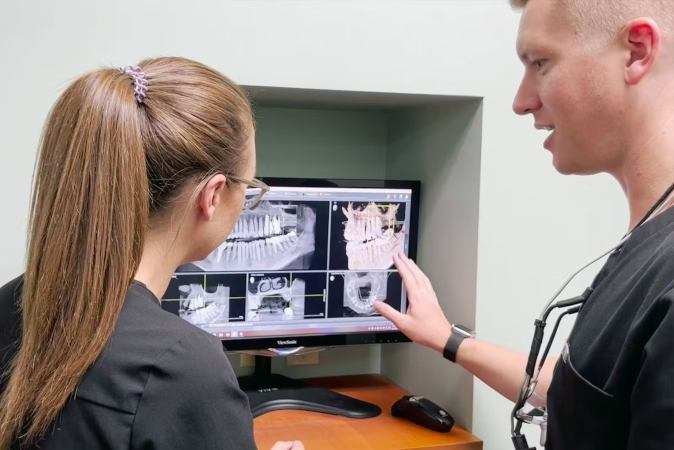
Dental implants at Atlas Dental Specialists are placed and restored by prosthodontists — a specialty that requires three additional years of post-doctoral training beyond dental school, focused entirely on tooth replacement, bite mechanics, and smile restoration. That distinction matters when you’re replacing a permanent tooth. At our Downtown Pittsburgh office at 650 Smithfield St., every step of your implant treatment — from the initial 3D imaging consultation through final crown delivery — is handled by the same specialist team, under one roof.
Each implant consists of three components working together: a titanium post anchored into the jawbone (which acts like a natural tooth root), an abutment connecting it to the surface, and a custom-crafted crown precisely matched to your natural teeth. The result is a replacement that looks, feels, and functions like a real tooth — with no impact on adjacent teeth, no slippage, and no ongoing bone loss the way a bridge or removable denture allows over time.
Dental implants are widely recognized as one of the most significant advances in restorative dentistry, according to patient education resources published by the American Dental Association. The titanium post fuses to the jawbone through a biological process called osseointegration, which is why a well-placed implant can function for decades. For patients missing several teeth or needing a broader restoration, our full mouth reconstruction services combine implants with other restorative options into a single treatment plan.
Not all dental implant providers are the same. A prosthodontist’s entire specialty is built around complex tooth replacement — which means the planning, placement, and final restoration are evaluated through a different lens than a general practice approach.
Drs. Mangini completed postgraduate prosthodontic residencies at the University of Pittsburgh School of Dental Medicine, with advanced training in both implant surgery and the restoration of implant-supported crowns — two skills most offices split between separate providers.
From digital scanning and 3D treatment planning to surgical placement and final crown delivery, your entire implant process stays at our Downtown Pittsburgh office at 650 Smithfield St. No referrals to outside oral surgeons, no coordination between separate offices.
Our practice has deep roots in the Downtown Pittsburgh community — more than three decades of complex restorative work, with patients referred by other local dental practices specifically because of our specialist expertise in implants and prosthodontics.
The implant process moves efficiently at our Downtown Pittsburgh office because everything happens in-house. Here’s what each phase involves:
We start with a comprehensive evaluation that includes 3D cone beam imaging to assess bone volume and plan precise implant positioning. If bone grafting is needed to prepare the site, we discuss that at this visit. You’ll leave with a clear treatment plan and a transparent cost breakdown before anything is scheduled.
The titanium post is placed into the jawbone under local anesthesia in a minimally invasive procedure. Most patients find the experience more comfortable than they expected. Post-placement recovery is typically 2–5 days before normal activity resumes, and a temporary restoration is placed so your appearance isn’t affected.
Over 3–6 months, the titanium post fuses with surrounding bone in a process called osseointegration — the biological foundation that makes implants last for decades. Regular check-ins monitor your healing progress. Some patients qualify for same-day implant protocols where a temporary crown is placed the day of surgery.
Once integration is confirmed, the abutment is attached and your custom crown — designed using CAD/CAM digital technology — is placed and fitted to match your natural teeth in color, shape, and bite. Because our prosthodontists handle both placement and restoration, there’s no hand-off mid-treatment and no coordination delays between separate specialists.
Every patient’s situation is different — and we’ll always recommend the option that best serves your oral health long-term, not the most complex one. Here’s how implants compare to the alternatives so you can have an informed conversation at your consultation:
| Factor | Dental Implants | Dental Bridge | Removable Denture |
|---|---|---|---|
| Typical lifespan | 25+ years with proper care | 10–15 years | 5–10 years |
| Bone preservation | Yes — stimulates bone like a natural root | No — bone continues to shrink beneath the bridge | No — accelerates bone loss over time |
| Adjacent teeth affected | None — no alteration to neighboring teeth required | Yes — teeth on either side must be prepared | None |
| Stability & feel | Fixed and stable — no slippage, functions like a natural tooth | Fixed, but can feel bulky at the gumline | Variable — slippage common as bone loss progresses |
| Best suited for | Long-term single tooth or full-arch replacement, patients with adequate bone | 1–3 adjacent missing teeth where budget or bone volume limits implants | Full-arch loss with significant bone loss, or where implants aren’t clinically indicated |
Active gum disease, uncontrolled systemic conditions, or significant bone loss may require preparation before implants can be placed. We evaluate all of this at your first consultation and will recommend the most appropriate path — which sometimes means a preparatory bone graft, periodontal treatment first, or an implant-supported bridge or denture when implants aren’t the right fit at this time. You’ll always get a clear, honest assessment — not a pressure-driven treatment plan.
Most adults who have lost one or more teeth are good candidates for implants. The most important factors we assess at consultation are:
Even if you’ve been told by another provider that you’re “not a candidate,” it’s worth a consultation at our Downtown Pittsburgh office. Many patients who were initially told implants weren’t possible have been successfully treated here after appropriate preparation — often a bone graft or periodontal treatment first. Our prosthodontists will give you a clear, honest assessment of what your specific situation requires.
At our Downtown Pittsburgh location, a complete single dental implant procedure is $6,364 — an all-inclusive price that covers the full treatment when no bone grafting or tooth extraction is required. We provide this upfront so there are no surprises mid-treatment.
We accept MetLife, Cigna, Principal, Ameritas, and UnitedHealthcare for qualifying services. Dental insurance typically covers a portion of implant-related costs — we’ll help you understand your benefits before committing to treatment. If your case requires bone grafting or preparatory treatment, we’ll provide a separate cost estimate for those steps at consultation so you have the full picture.
Ready to take the next step? Schedule a consultation at our Downtown Pittsburgh office at 650 Smithfield St., Suite 2100, or call us at (412) 730-2560.


Dr. Mara Mangini is a Pittsburgh native and prosthodontist who earned her DMD from the University of Pittsburgh School of Dental Medicine in 2011, followed by a three-year prosthodontics residency at Pitt. A former Clinical Associate Professor at Pitt Dental School, she brings specialty-level expertise in smile design, full-mouth restorations, dental implants, Invisalign, and same-day crowns. She is a member of the American College of Prosthodontics, the American Dental Association, and the Academy of Osseointegration.
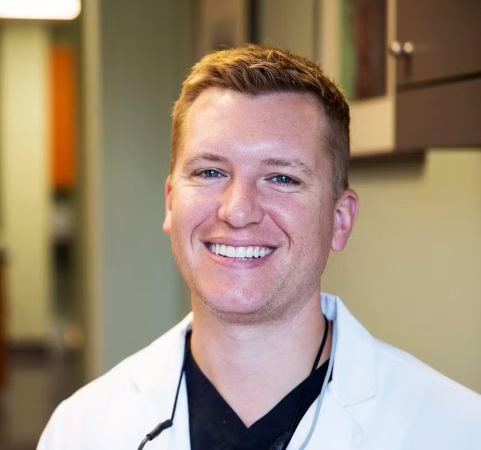
Dr. Nicholas Mangini is a prosthodontist and implant specialist originally from Erie, PA. He earned his DMD from the University of Pittsburgh School of Dental Medicine and completed his three-year prosthodontics residency at Pitt, where he later served as a Clinical Associate Professor. He specializes in dental implants, full-mouth reconstruction, same-day crowns, and digital dentistry using 3D printing and CAD/CAM technology. He is a member of the American College of Prosthodontics, the Academy of Osseointegration, and the American Dental Association.

Dr. Komal Shaikh earned her DMD from the University of Pittsburgh School of Dental Medicine in 2020 and completed her General Practice Residency at the University of Texas in Houston, where she treated medically complex patients and those with special needs — including patients in the operating room under sedation. She practiced in Houston and New York before moving back to Pittsburgh, where she treats patients of all ages with a focus on patient education, clear communication, and a gentle touch.
At our Downtown Pittsburgh location, a complete single dental implant procedure is $6,364. This all-inclusive price covers the titanium post, abutment, and crown when no bone grafting or tooth extraction is required. Financing through CareCredit breaks this into manageable payments: approximately $1,061/month at 0% interest for 6 months, or approximately $172/month on an extended 60-month plan.
If bone grafting, a sinus lift, or tooth extraction is needed before implant placement, those are quoted as separate line items at your consultation — so you have the full cost picture before committing to treatment. We accept MetLife, Cigna, Principal, Ameritas, and UnitedHealthcare for qualifying services, and will verify your benefits upfront. Because our prosthodontists handle both placement and restoration in-house, you won’t encounter the fragmented pricing that comes with splitting care between an oral surgeon and a separate restorative dentist.
General dentists, oral surgeons, periodontists, and prosthodontists can all place dental implants, but their training scope differs significantly. Oral surgeons and periodontists receive advanced training in the surgical placement of the implant itself, but typically refer patients to a restorative dentist or prosthodontist for the crown and finishing work. That handoff between providers adds coordination complexity, extends treatment timelines, and can create inconsistency in how the final restoration is designed.
Prosthodontists are the only specialists with advanced formalized training in both implant placement and implant-supported restoration — meaning they plan the crown from the beginning and engineer the surgical approach around the final result. At Atlas Dental Specialists, Drs. Mangini place the implant, fabricate the abutment, and deliver the final crown — all in-house, without referring out. For complex cases involving full-mouth reconstruction, multiple missing teeth, or bite correction, that unified approach makes a measurable difference in outcomes.
The key structural difference is how each option interacts with the jawbone. A dental bridge spans a gap by anchoring to the teeth on either side, which must be permanently prepared (filed down) to accept the bridge crowns. The gap underneath the bridge gets no stimulation, so the jawbone gradually shrinks beneath it — a process that becomes visible as a sunken appearance over time. The bridge itself typically needs replacement after 10–15 years.
A dental implant replaces the root, not just the crown. The titanium post integrates with the bone and provides the same stimulation a natural tooth root would, halting bone loss at the site. No adjacent teeth are altered. With proper maintenance, an implant and its crown can last 25+ years or longer. Over the lifetime of the restoration, implants are often more cost-effective than bridges that require periodic replacement. The right choice depends on bone volume, number of teeth missing, and budget — we’ll walk through the comparison at your consultation and recommend based on your specific anatomy, not a standard protocol.
Dental implant placement is classified as minor oral surgery — it’s performed in our Downtown Pittsburgh office under local anesthesia, not in a hospital or general anesthesia facility. Most patients compare it to a tooth extraction in terms of discomfort during and after the procedure. The surgical window is typically 30–60 minutes per implant, and most patients return to normal activity within 2–5 days.
The minimally invasive approach we use at Atlas Dental Specialists — guided by 3D cone beam imaging that maps your bone anatomy before surgery — reduces the incision footprint and improves placement accuracy. Post-operative soreness is managed with over-the-counter pain relievers in most cases; prescription medication is available when needed. The recovery timeline for osseointegration (3–6 months for the bone to fully fuse with the implant) is longer, but that period involves no significant discomfort — it’s passive healing while you go about your normal life with a temporary restoration in place.
Our dental practice is conveniently located in Centre City Tower, at the corner of Smithfield and Seventh Ave.