Retirement-Ready Smiles: How All-on-4 Improves Quality of Life for Seniors

Happy active senior couple outdoors

Retirement is supposed to be the chapter where you finally get to enjoy things: meals with family, travel, social dinners, and all the moments you spent decades working toward. But for seniors living with failing teeth, loose dentures, or significant tooth loss, even the simplest pleasures, like ordering freely at a restaurant or laughing without hesitation, can become sources of daily stress. The good news is that this doesn’t have to be permanent, and for many patients, it doesn’t take nearly as long to fix as they expect.

At Atlas Dental Specialists in Pittsburgh, Dr. Nicholas Mangini and the team work with seniors every day who are ready to reclaim those moments. As prosthodontists with over 35 years of combined history serving the Pittsburgh community, we take a full-service approach to All-on-4 implants, meaning patients can have their implants and final restoration completed all in one place, with no need to see multiple specialists at separate offices.

What Patients Say They Get Back

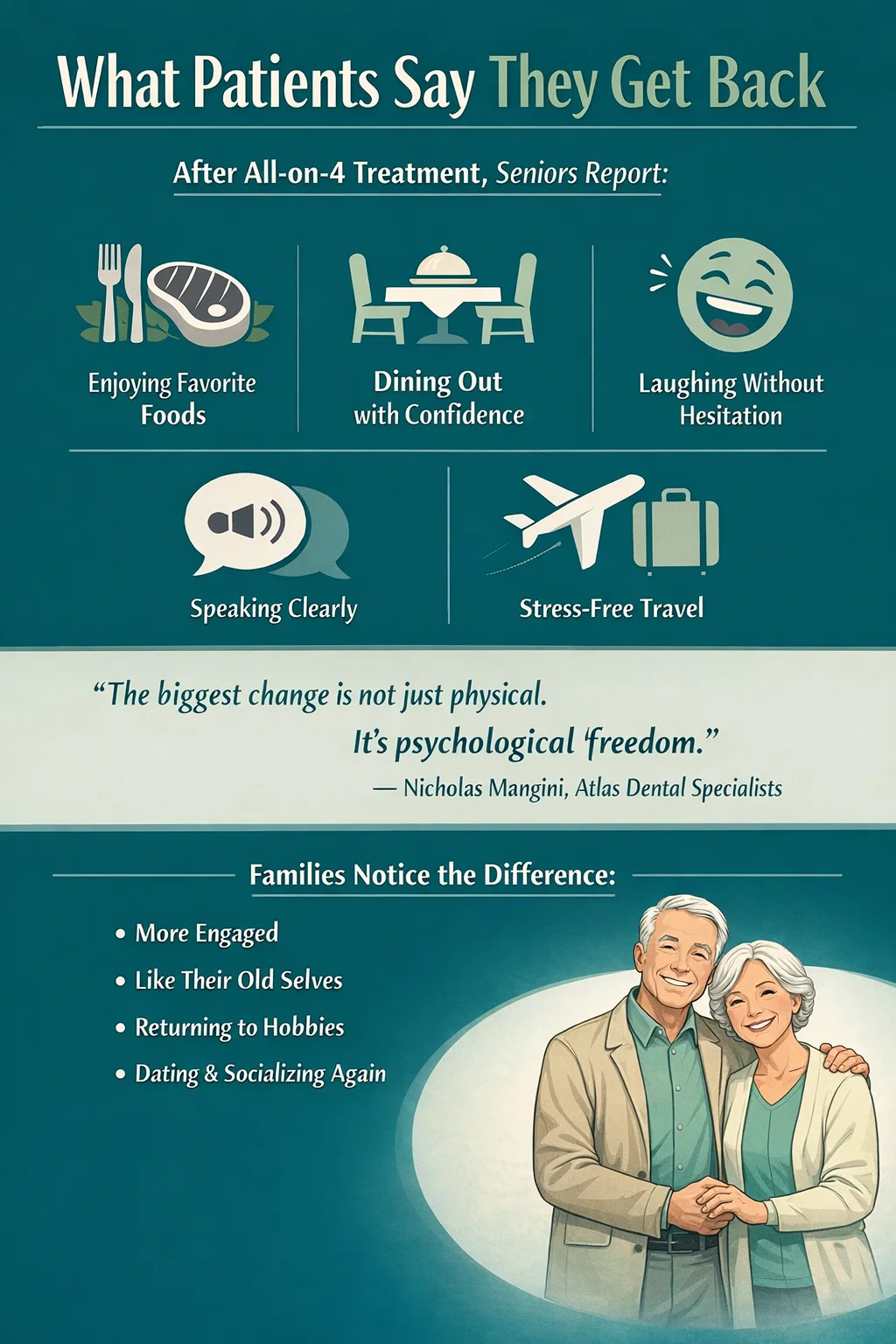
The list of things seniors report being able to enjoy again after all-on-4 treatment is consistent from patient to patient.

“Patients frequently tell me they can eat foods they haven’t enjoyed in years, dine out without anxiety, laugh freely without covering their mouth, speak more clearly, and travel without denture adhesives or soaking solutions,” says Dr. Mangini. “The biggest change is not just physical. It’s psychological freedom.”

That psychological shift is something families notice, too. Dr. Mangini regularly hears from relatives who say their parent or spouse seems “like themselves again,” more engaged, more present, and more willing to show up to the moments that matter. Some patients return to public-facing roles or hobbies they had quietly stepped away from. Others start dating again. The changes extend well beyond the mouth.

Addressing the Cost Concern

One of the most common things Dr. Mangini hears from senior patients considering all-on-4 is some version of: “I’m too old to spend that much money on my teeth.” His response is direct and consistent.


“If you’re 65, you may have 20 to 30 vibrant years ahead,” Dr. Mangini explains. “Those years include meals with family, travel, celebrations, and daily enjoyment. Teeth affect how you eat, speak, and smile every single day. This isn’t cosmetic vanity. It’s quality of life.” He encourages patients to think about value, not just cost, and notes that many tell him later it was one of the best decisions they ever made for themselves.

Research supports this perspective. A 2022 systematic review published on PubMed found that oral health-related quality of life and patient satisfaction were consistently high among patients rehabilitated with the all-on-4 concept, across studies with follow-up periods ranging from three months to seven years.
Atlas Feb Blog Graphic What Seniors Get Back - Atlas Dental Specialists


What Recovery Actually Looks Like


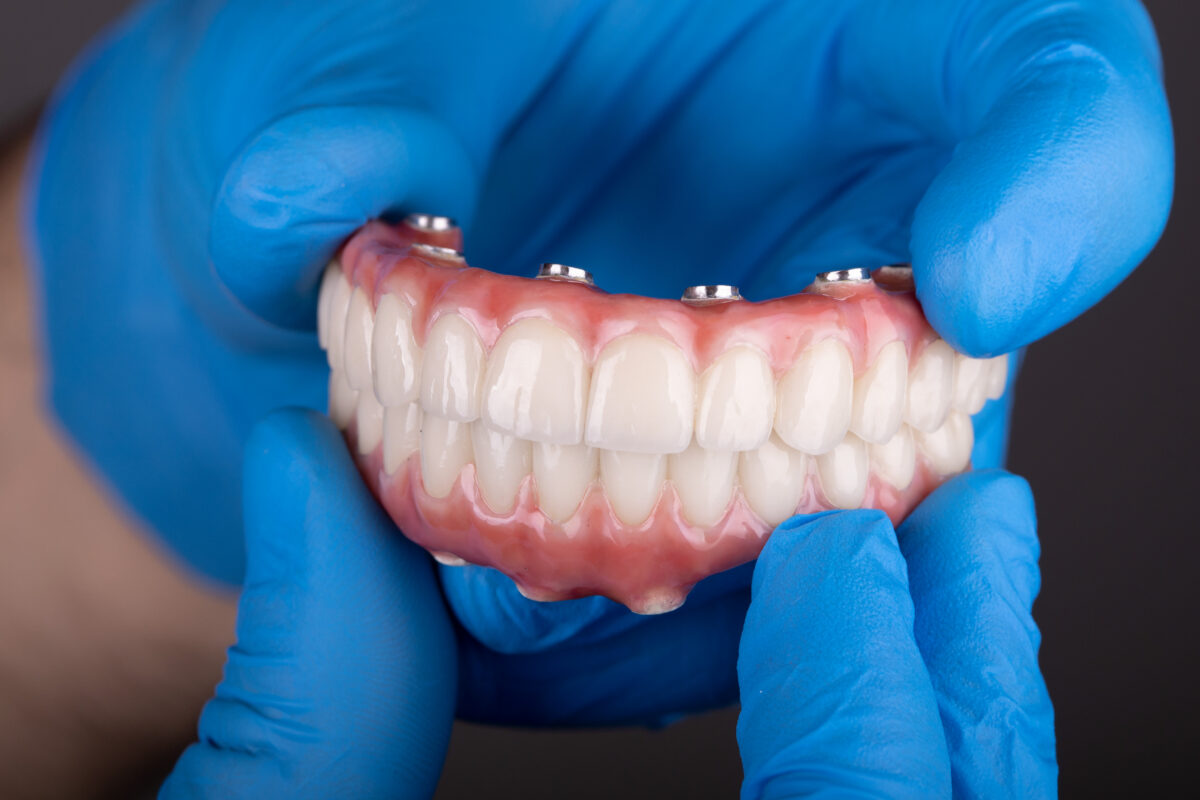
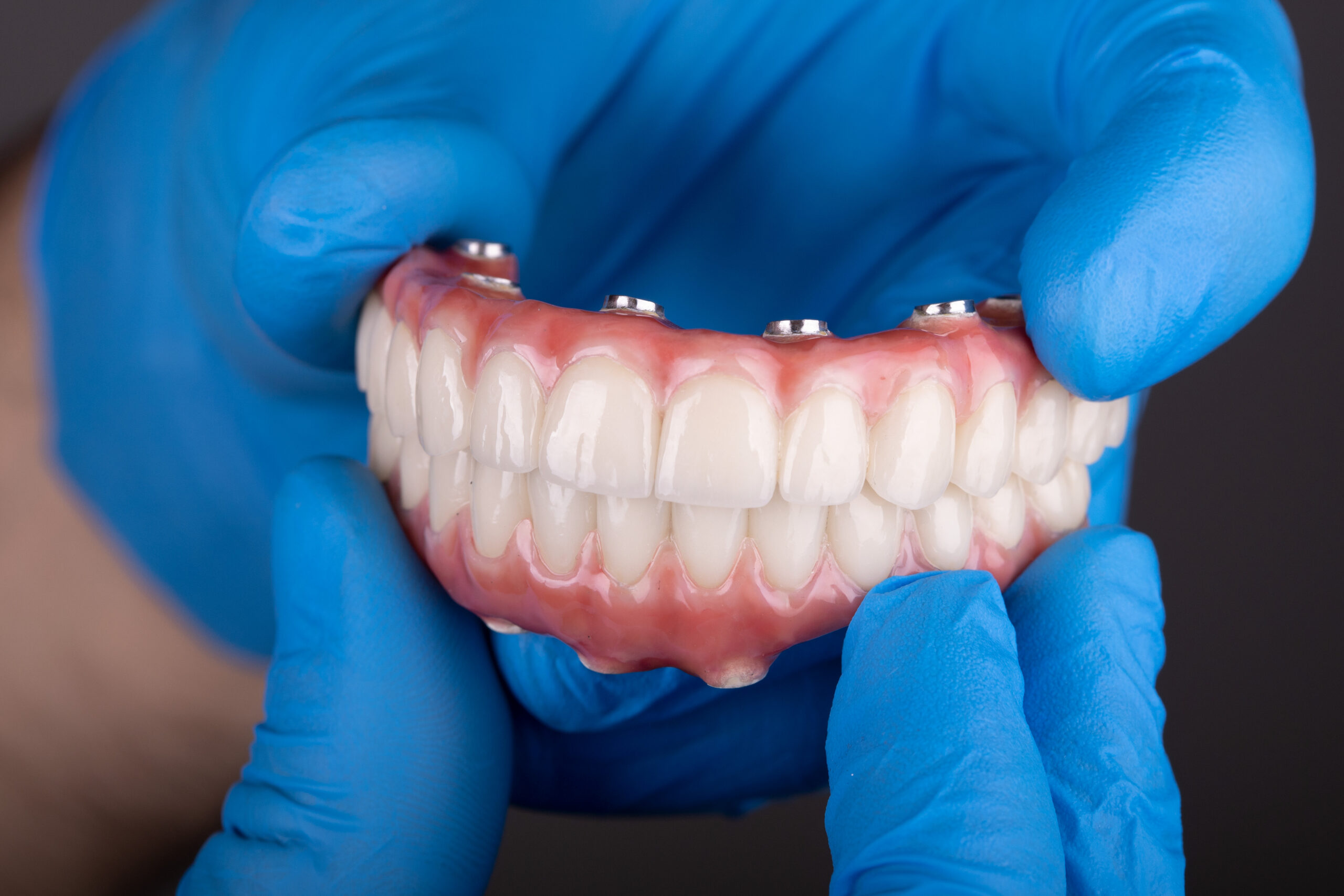
Many seniors are surprised to learn how manageable the recovery process tends to be. In most cases, we place a fixed provisional prosthesis the same day as surgery, so patients leave with teeth.

The typical experience in the days that follow looks like this:

  • Mild to moderate swelling for three to five days
  • Bruising that may occur occasionally
  • Soreness that is manageable with prescribed medication
  • Temporary diet modification during the initial healing period

Healing continues over several months as the implants integrate, but patients often adapt to their new teeth faster than they anticipated. “Most are pleasantly surprised,” says Dr. Mangini. “They adapt quickly.” For patients interested in understanding each stage of what to expect, our dental implant guide walks through the full process in plain terms.

Why Fixed Solutions Work Better for Active Retirees

For seniors with active retirement lifestyles, the practical advantages of a fixed solution over removable options add up quickly. There is no adhesive to apply, no soaking container to travel with, no removal routine at night, and no anxiety about movement during meals.

Daily maintenance involves brushing, water flossing, and routine professional cleanings, much like natural teeth. For patients who travel frequently or are simply done managing the logistics that come with removable dentures, the consistency and reliability of a fixed full-arch restoration make a meaningful difference. Those who have tried both options tend to say the same thing: they wish they had made the switch sooner.

Schedule Your Consultation at Atlas Dental Specialists

Dr. Mangini and the team at Atlas Dental Specialists bring prosthodontic training and decades of experience to every full-arch case. With offices in both Shadyside and Downtown Pittsburgh, we provide a warm, family-centered environment where patients can get honest answers, a thorough evaluation, and a clear picture of what treatment may be able to offer them. Patients can also explore full-mouth reconstruction options as part of a comprehensive plan.

If you’re ready to find out whether all-on-4 is the right fit for your retirement years, we’d love to hear from you. Schedule your consultation with Atlas Dental Specialists today.


All-on-4 Implants After 50: Why Age Shouldn’t Stop Your Smile Transformation

Portrait of happy senior man smiling at home. Old man relaxing on sofa and looking at camera. Portrait of elderly man enjoying retirement.If you’ve been living with failing teeth or dentures that never quite fit, you may have convinced yourself it’s too late to do anything about it. That feeling is one of the most common things patients over 50 bring into a first consultation, and it deserves a direct answer: age alone does not determine whether someone is a good candidate for full-arch implants. What matters far more is overall health, bone quality, and whether you’re medically stable enough for the procedure. For most people in their 50s, 60s, 70s, and beyond, the outlook is far more encouraging than they expect.
At Atlas Dental Specialists in Pittsburgh, Dr. Nicholas Mangini and the team take a prosthodontically driven approach to full-arch restoration, meaning we plan the final teeth first and then design each implant placement to support that result safely and predictably. That method guides every consultation we hold for patients considering all-on-4 implants, and it’s one reason so many patients over 50 walk out of our offices with a completely different outlook on what treatment may be able to offer them.

What Patients Over 50 Get Wrong

The most common question Dr. Mangini hears at the start of a consultation is some version of: “Am I too old for this?” His answer is nearly always no.

“Age itself is not the deciding factor,” Dr. Mangini explains. “I treat many patients in their 50s, 60s, 70s, and even 80s who are excellent candidates. What matters more is overall health, bone quality, and whether someone is medically stable.”

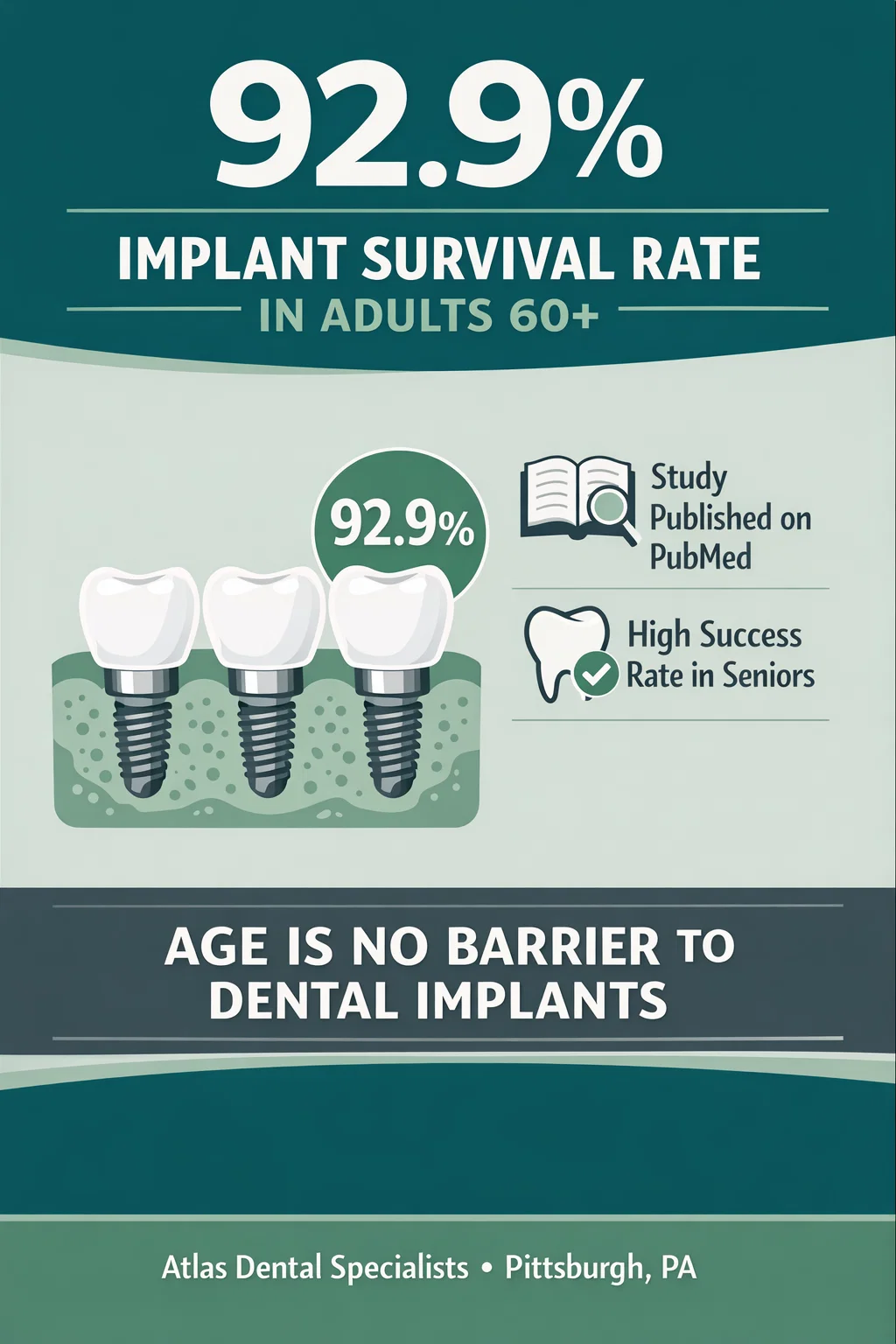
Many patients also assume that the procedure will be painful or that recovery takes weeks. In practice, most say the experience was far easier than they expected, often less uncomfortable than having multiple failing teeth removed over time. A common concern is that significant bone loss rules someone out entirely, but the all-on-4 technique is built to work with existing bone and typically avoids extensive grafting. A study published in PubMed found an overall implant survival rate of 92.9% in adults aged 60 and older, confirming that age alone is not a barrier to a successful outcome.

How the Options Compare

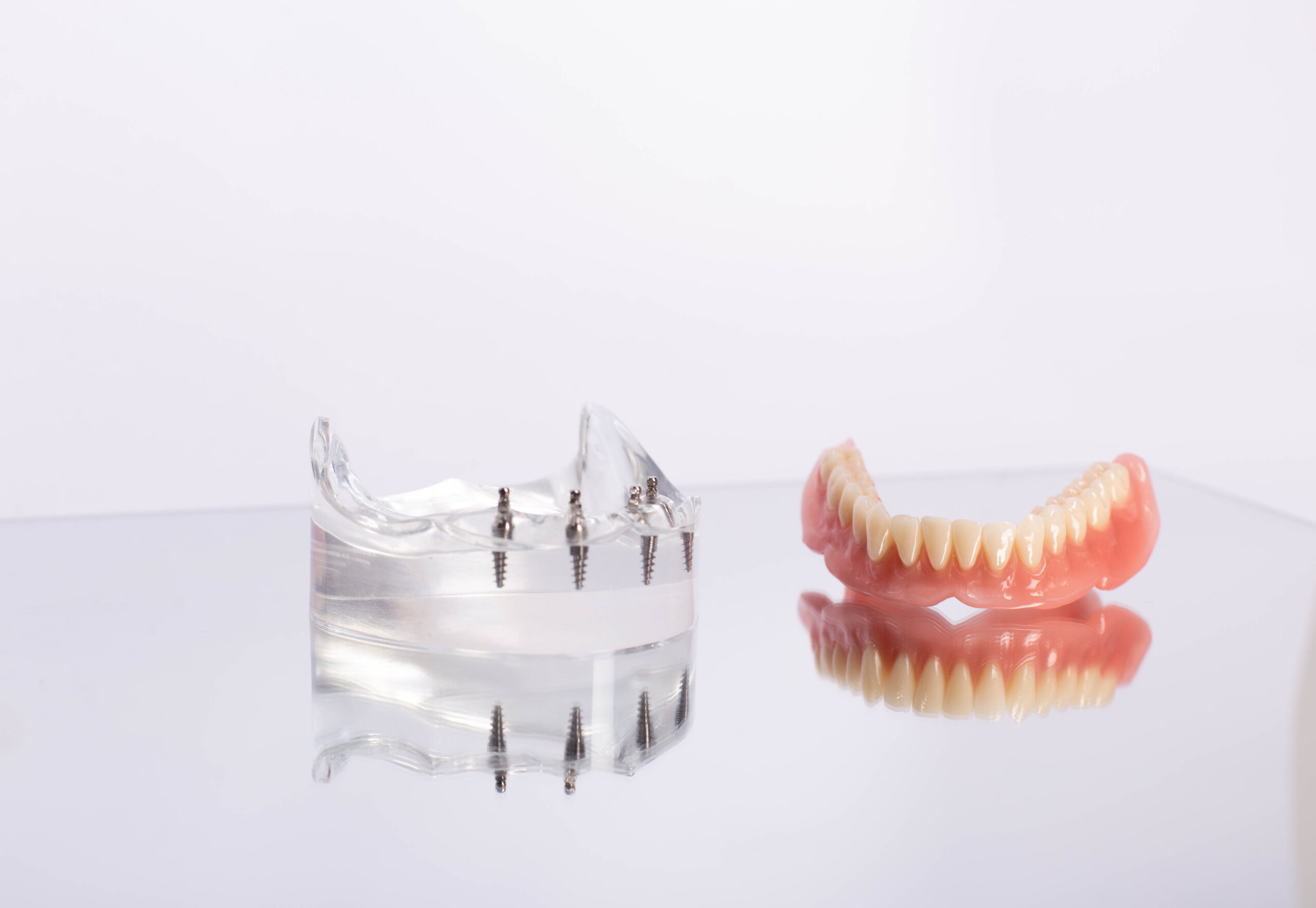
Dr. Mangini frames the comparison in practical terms, because the right solution depends entirely on how a patient wants to live day to day. Traditional dentures sit on the gums and rely on suction and adhesives. Bone loss continues over time, fit can change, and chewing efficiency stays limited. Implant-supported dentures offer more stability but are still removable, still come out nightly, and still require a daily cleaning routine. All-on-4 is fixed, does not come out, and functions much more like natural teeth.

“For many patients over 50, the decision comes down to one question,” says Dr. Mangini. “Do I want something removable, or do I want something that feels permanent?” Patients who begin with a removable solution and later upgrade often say they wish they had understood the lifestyle difference from the start, particularly the greater chewing efficiency, the absence of a nightly removal routine, and the more natural everyday feel that a fixed restoration provides.

Atlas Feb Blog Graphic Implant Survival Rate

What We Look at Before Moving Forward

Every consultation at Atlas Dental Specialists includes a careful review of the factors most likely to affect candidacy and outcomes. We evaluate several key areas before recommending any treatment plan.

Those areas include:

  • Bone density and volume: adequate bone is needed to anchor implants securely
  • Diabetes control: well-managed diabetes is generally not a barrier to treatment
  • Cardiovascular health: many heart conditions are manageable with physician coordination
  • Medications: blood thinners and osteoporosis drugs may require careful planning
  • Smoking history: smoking affects healing and is always factored into the overall approach
  • Healing capacity: modestly slower in older adults, but not significantly so in healthy individuals

“What matters most is systemic stability,” says Dr. Mangini. For patients who want to understand the process before coming in, our dental implant guide breaks down every stage of treatment in plain terms.

What Real Results Look Like

Dr. Mangini recently treated a man in his early 60s who had spent years managing failing teeth and partial dentures. He avoided steak, apples, and social dinners out of embarrassment, and he smiled with his lips closed in every photo. Before treatment, he told Dr. Mangini he just wanted to feel normal again. After completing a full-arch all-on-4 restoration, the change was clear within weeks. He was eating comfortably and without hesitation, and at his follow-up he said he had gone out to dinner with friends and ordered whatever he wanted without giving it a second thought.

“What stood out most wasn’t the functional improvement,” Dr. Mangini recalls. “It was his posture, his eye contact, his willingness to smile. He looked ten years younger — not because of the teeth alone, but because of the renewed confidence. That’s the part of this treatment that never gets old for me.”

Schedule a Consultation at Atlas Dental Specialists

At Atlas Dental Specialists, Dr. Mangini and our team bring prosthodontic training and decades of experience to every full-arch case, with offices in Pittsburgh’s Shadyside and Downtown neighborhoods. We plan each restoration from the final outcome backward, placing implants in positions that deliver stable, lasting results. Patients can also learn more about our approach and background on Dr. Mangini’s bio page.

If you’ve been putting this off, now is a good time to reach out. We’re here to evaluate your situation, answer your questions honestly, and help you understand what treatment may be able to offer you. Schedule your consultation with Atlas Dental Specialists today.

What Is All-on-4? A Complete Guide to Full-Mouth Dental Restoration

Mandibular prosthesis All on 4 system supported by implants. Medically accurate 3D illustration of human teeth and dentures concept

Living without a full set of functional teeth affects more than just your smile. Eating becomes a challenge, speaking clearly grows difficult, and the confidence you once had begins to fade. For many people facing extensive tooth loss, traditional solutions like removable dentures create their own frustrations. Fortunately, All-on-4 allows you to replace your missing teeth in a more streamlined, comfortable way.

Atlas Dental Specialists offers advanced solutions for complete tooth replacement through modern implant dentistry. With over 25 years of serving Pittsburgh and specialized training in prosthodontics, Drs. Nicholas and Mara Mangini provide comprehensive treatment options that restore both function and confidence.

How the All-on-4 Concept Works

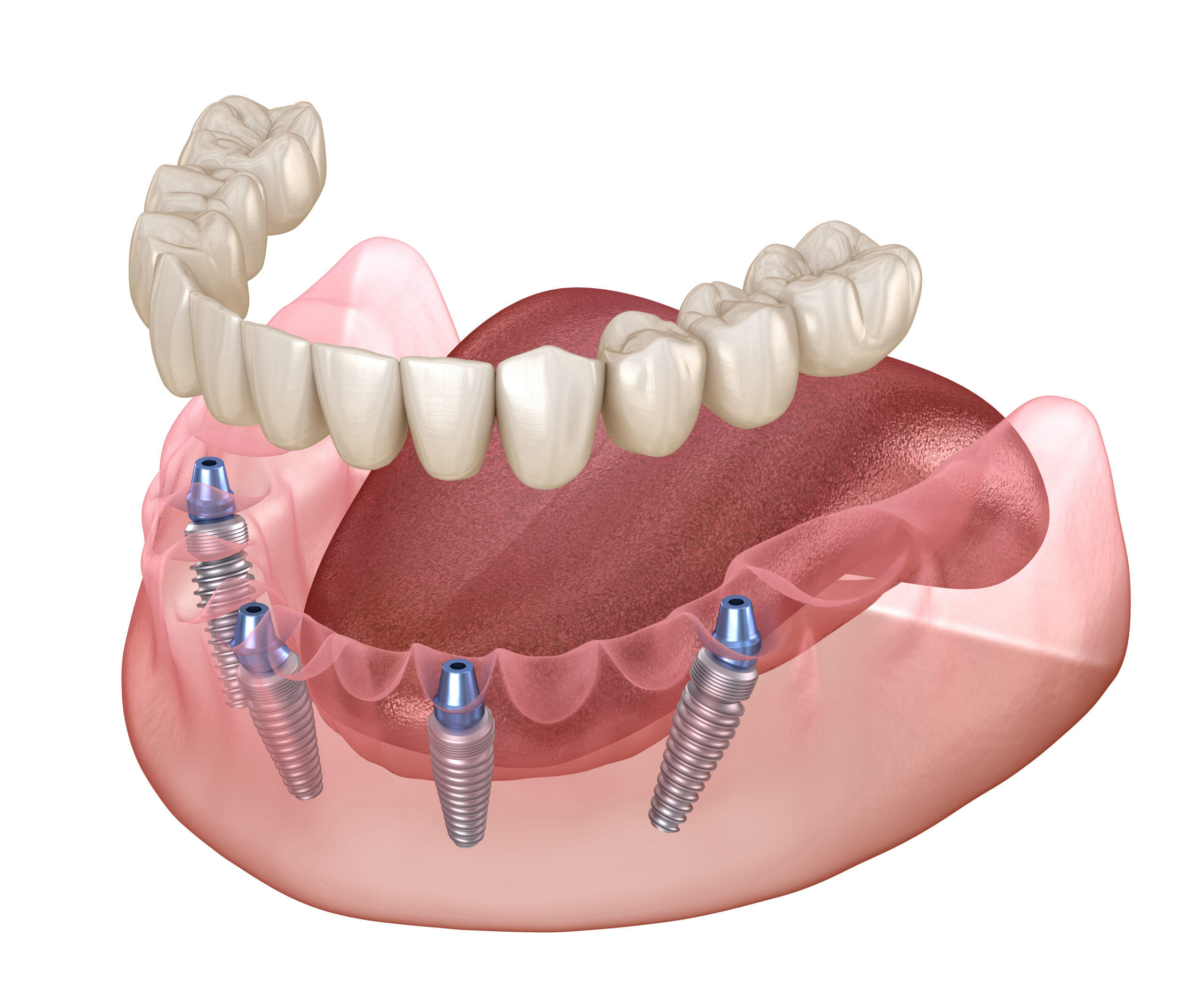
All-on-4 uses just four strategically positioned implants to support an entire arch of replacement teeth. The technique maximizes available bone while minimizing surgical complexity, allowing many patients to leave the office with functional teeth on the same day as their implant placement.

The system relies on precise implant positioning to distribute biting forces evenly across the jaw. Two implants are placed vertically in the front where bone density tends to be strongest. The two posterior implants are angled up to 45 degrees, bypassing areas of bone loss and engaging with denser bone further back. This strategic placement eliminates the need for bone grafting in many cases and creates a stable foundation for the prosthetic arch.

The immediate-load protocol means the temporary prosthesis is attached to the implants within hours of surgery. Patients receive their permanent restoration once osseointegration is complete, a process where the bone fuses with the titanium implants that typically takes three to six months.

Who Benefits Most From All-on-4 Treatment?

Ideal candidates include people who have lost all their teeth or face the extraction of all remaining teeth in an arch. Those currently wearing traditional dentures who struggle with poor retention or discomfort often find this solution transformative. Research published by the Journal of Functional Biomaterials demonstrates the reliability of this approach, with studies showing prosthesis survival rates exceeding 97%.

Patients with significant bone loss who might otherwise require extensive grafting procedures also benefit from the All-on-4 design. The angled posterior implants access denser bone areas that remain unaffected by resorption. However, adequate bone volume in specific locations remains necessary, and certain medical conditions may affect candidacy.

The Treatment Process From Start to Finish

Your journey begins with comprehensive diagnostics, including 3D cone beam imaging and detailed treatment planning. This imaging allows us to map your bone structure precisely and identify optimal implant positions. Any remaining teeth scheduled for extraction are removed during the same appointment as implant placement.

On surgery day, you receive appropriate sedation or anesthesia for comfort. The four implants are positioned according to the pre-planned locations, and the temporary prosthetic arch is secured. Most patients report minimal discomfort during recovery, which typically involves a soft diet for several weeks. Follow-up appointments monitor the integration process and allow for any necessary adjustments.

After osseointegration is confirmed, you return for the placement of your permanent prosthesis. This final restoration is custom-fabricated to match your facial proportions, desired tooth shade, and bite specifications.

Comparing All-on-4 to Other Restoration Options

Traditional dental implants replace individual teeth with separate implant posts and crowns. For full-arch restoration, this could mean eight to ten implants per arch with associated costs and surgical complexity. All-on-4 reduces both the number of implants needed and the overall treatment timeline while still providing a permanently fixed solution.

Removable dentures represent the most conservative option in terms of initial investment, but they come with ongoing challenges. Adhesives, regular adjustments, and eventual replacement create long-term costs that can approach or exceed implant treatment. More importantly, dentures don’t prevent the continued bone loss that occurs when tooth roots are missing. The stimulation provided by implants helps maintain bone volume and facial structure over time.

Life With Your All-on-4 Restoration

Caring for your implant-supported prosthesis involves daily brushing and the use of interdental cleaners to remove debris around the implant sites. Regular professional cleanings at six-month intervals allow your dental team to monitor implant health and the condition of your prosthesis. Unlike natural teeth, implants cannot develop cavities, but the surrounding gum tissue requires attention to prevent inflammation.

Dietary restrictions are minimal once healing is complete and the permanent prosthesis is in place. Most patients enjoy a regular diet, including foods they avoided with traditional dentures. The fixed nature of All-on-4 means no worries about prosthesis movement during eating or speaking.

Experience Comprehensive Care at Atlas Dental Specialists

The success of full-arch restoration depends significantly on the skill and experience of your treatment team. Dr. Nicholas Mangini completed advanced prosthodontic training, with a focus on complex restorative procedures and implant dentistry. This specialized expertise ensures precise treatment planning and execution throughout your restoration journey. The team at Atlas Dental Specialists provides comprehensive care from initial consultation through final prosthesis delivery without requiring referrals to multiple specialists.

If you’re ready to explore whether All-on-4 treatment aligns with your restoration goals, contact our office to schedule a consultation. Our team will evaluate your specific situation, discuss all available options, and develop a treatment plan tailored to your needs and expectations.

Dental Care After 50: What Changes to Look For and How to Restore Your Smile

Perfect smile. Calm happy senior female patient sitting at the dentist chair and smiling after the treatment. Pensioner woman visiting stomatology cabinet concept. Stock photo

Your teeth have been with you for decades, but once you hit 50, they start sending different signals. Maybe you notice your gums pulling back more than they used to, or that morning coffee stings a bit. These aren’t just random annoyances; they’re signs that your mouth is aging, and ignoring them can lead to bigger problems down the road.

Atlas Dental Specialists in Pittsburgh understands the unique dental challenges that come with age. Led by prosthodontists Drs. Nicholas and Mara Mangini, this family-owned practice has been helping patients over 50 maintain healthy, confident smiles through advanced restorative dentistry and personalized care. Whether you’re dealing with tooth loss, gum recession, or worn-down enamel, we provide comprehensive solutions without the need for referrals to multiple specialists.

Why Your Teeth Change After 50

As you age, your mouth goes through some real changes. Your gums naturally recede, exposing tooth roots and making them more vulnerable to decay. According to the CDC, approximately 20% of adults 65 and older have untreated dental caries, and many of these issues start in your 50s when preventive care becomes even more important.

Dry mouth becomes more common, too. If you take medications for blood pressure, cholesterol, or other conditions, there’s a good chance at least one of them is reducing your saliva production. Less saliva means your mouth can’t wash away food particles and bacteria as effectively, which increases your risk for cavities and gum disease. Your enamel also thins out over time, which can cause sensitivity and make your teeth look more yellow as the darker dentin underneath starts to show through.

Common Dental Problems After 50

The dental issues that emerge after 50 often develop gradually, making them easy to overlook until they become serious. Understanding what to watch for can help you address problems early and preserve your natural teeth longer.

Gum Disease and Recession

Gum disease doesn’t always announce itself with pain, which is part of what makes it so dangerous. You might notice your gums bleeding when you brush or looking puffier than usual. Left untreated, gum disease can progress to the point where it damages the bone supporting your teeth, leading to tooth loss. Advanced periodontal treatments can address these issues before they become severe.

Tooth Loss and Bone Loss

When you lose a tooth, the bone in that area starts to deteriorate because the tooth root is no longer stimulating it. This bone loss can change the shape of your face and make it harder to fit dentures properly if you go that route. Dental implants prevent this bone loss by acting as artificial roots that keep your jawbone healthy and strong.

Worn Teeth and Old Restorations

Years of chewing, grinding, and clenching take their toll. You might have fillings or crowns from decades ago that are starting to fail. Cracks can develop in old restorations, creating hiding places for bacteria that can cause new decay. If your teeth are significantly worn down or you’re dealing with multiple failing restorations, full mouth reconstruction might be the best way to restore both function and appearance.

How to Restore Your Smile After 50

If you have dental issues from aging, modern dentistry offers more options than ever for rebuilding your smile. You’re not stuck with whatever issues age has handed you, and today’s treatments, including the following, are more comfortable and efficient than ever:

Dental Implants for Missing Teeth

Dental implants have become the gold standard for replacing missing teeth because they look, feel, and function like natural teeth. Unlike dentures, which can slip around, implants are permanently fixed in your jaw. They also prevent the bone loss that happens when teeth are missing. For patients missing multiple teeth, implant-supported dentures offer a middle ground between traditional dentures and fully fixed implants.

Cosmetic Solutions for Aging Teeth

If your teeth are stained, chipped, or misshapen, cosmetic treatments like porcelain veneers can transform your smile in just a few visits. Veneers are thin shells of dental porcelain that cover the front surfaces of your teeth, hiding imperfections and giving you a brighter, more uniform appearance.

Same-Day Crowns for Damaged Teeth

For damaged teeth that are structurally sound, dental crowns provide protection and restore shape and strength. Atlas Dental Specialists uses advanced CAD/CAM technology to create crowns in-office, so you can often get your permanent crown on the same day rather than waiting weeks with a temporary.

Restore Your Smile at Atlas Dental Specialists

As prosthodontists, Drs. Nicholas and Mara Mangini have completed years of additional education beyond dental school, specializing in complex restorative cases and dental implants. Their family-owned practice has served Pittsburgh for over 35 years, building a reputation for comprehensive care that addresses all aspects of oral health. We make same-day dentistry possible through CAD/CAM technology, 3D printing, and in-office milling, and we offer flexible financing options and a membership club for patients without insurance.

If you’re ready to address the dental changes that come with age and restore your smile, contact Atlas Dental Specialists today. Our Pittsburgh team provides expert care for everything from single-tooth replacements to complete smile makeovers, all under one roof, without referrals.

All-on-4 vs. Individual Dental Implants: Which Is Right for You?

Woman talk to dentist in dental clinic

Choosing between full-arch restoration and individual tooth replacement can be difficult, but with the right dental team and a better understanding of each treatment, you can make the right choice for your smile. The path you select affects not only your immediate treatment experience but also your long-term oral health, daily comfort, and financial investment.

At Atlas Dental Specialists, Drs. Nicholas and Mara Mangini bring specialized prosthodontic training to guide patients through complex implant decisions. As a full-service provider of all-on-X dental implants, our Pittsburgh practice offers both treatment options under one roof, eliminating the need for referrals to multiple specialists. With over 35 years of combined expertise in implant prosthetics and full-mouth reconstruction, we help patients understand which solution best serves their unique situation.

Understanding Individual Dental Implants

Individual dental implants replace missing teeth one at a time by surgically placing a titanium post into the jawbone. Each implant functions as an independent artificial tooth root, supporting its own custom crown. This approach works exceptionally well for patients missing single teeth or those with multiple non-adjacent gaps in their smile.

The treatment typically unfolds in stages. After the initial surgical placement, patients wait three to six months for osseointegration to occur, allowing the bone to fuse with the implant. Once healing completes, the dentist attaches an abutment and places the final crown. Each tooth receives individual attention, resulting in highly customized restorations that closely mimic natural tooth structure and appearance.

Individual implants require adequate bone density at each placement site. Patients who have experienced significant bone loss may need grafting procedures before implant surgery, extending the overall treatment timeline. However, this method offers maximum flexibility, allowing dentists to address specific areas of tooth loss without committing to full-arch restoration.

How All-on-4 Implants Work

The all-on-4 system takes a dramatically different approach by supporting an entire arch of replacement teeth with just four strategically positioned implants. Two implants are placed vertically in the front of the jaw, while two posterior implants are angled at 30 to 45 degrees to maximize contact with available bone. This technique allows patients to receive full-arch restoration even when bone density has diminished, as the angled placement helps avoid areas with insufficient bone structure.

This method offers immediate function, with temporary prosthetic teeth often attached the same day as implant placement. The four implants connect to a metal framework that evenly distributes chewing forces across the jaw, providing stability comparable to that of natural teeth. Patients leave the dental office with functional teeth rather than waiting months between procedures.

The all-on-4 approach typically avoids the need for bone grafting by strategically working with existing bone. This reduces both treatment complexity and recovery time compared to placing six to eight individual implants across a full arch. The streamlined process makes full-mouth restoration accessible to patients who might otherwise face extensive preliminary procedures.

Key Differences Between All-on-4 and Individual Implants to Consider

Various factors distinguish these treatment paths. Understanding the following distinctions helps clarify which option aligns with your dental needs and lifestyle:

  • Treatment timeline: Individual implants require three to six months of healing per tooth before final restoration, while all-on-4 patients often receive temporary teeth immediately and complete treatment within a few months.
  • Number of procedures: Replacing a full arch with individual implants involves multiple surgical sessions, whereas all-on-4 consolidates implant placement into a single appointment.
  • Bone requirements: Each individual implant requires adequate bone at its specific location, potentially necessitating grafts, while the angled implant technique in all-on-4 systems maximizes use of available bone.
  • Cost structure: For full-arch replacement, all-on-4 proves more cost-effective than placing eight to ten individual implants, though individual implants offer better value when replacing just one or a few teeth.
  • Maintenance approach: Individual implants allow for standard brushing and flossing around each crown, while all-on-4 prosthetics require specialized cleaning techniques around the supporting framework.

The choice between these approaches ultimately depends on how many teeth you need replaced and your specific oral health situation.

How to Choose the Right Dental Implant Option

The right choice depends on your specific dental situation. Individual dental implants work best for patients with isolated tooth loss, good bone density, and the flexibility to undergo treatment over an extended period. The all-on-4 option serves patients seeking comprehensive advanced tooth replacement who need immediate function or wish to avoid complex bone grafting procedures.

Your overall oral health, bone condition, budget constraints, and personal preferences all play crucial roles in determining the optimal approach. During a consultation, prosthodontists use advanced imaging to assess your jawbone structure and discuss how each option addresses your specific needs. Our team evaluates factors including remaining teeth, bite alignment, and long-term maintenance requirements to recommend the solution that best supports your oral health goals.

Restore Your Smile With Dental Implants at Atlas Dental Specialists

Choosing between all-on-x and individual dental implants requires expert guidance from specialists trained in complex implant procedures. At Atlas Dental Specialists, our prosthodontists handle everything from initial consultation through final restoration in our downtown Pittsburgh and Shadyside locations. As a full-service provider, you receive both the implant placement and crown fabrication in one practice, eliminating the need to coordinate care across multiple dental offices.

Whether you need to replace a single tooth or restore an entire arch, our team provides personalized treatment plans tailored to your unique needs. Contact our team today to discuss which implant solution aligns with your smile restoration goals.

Bone Loss and All-on-X: How Implants Preserve Your Jawbone

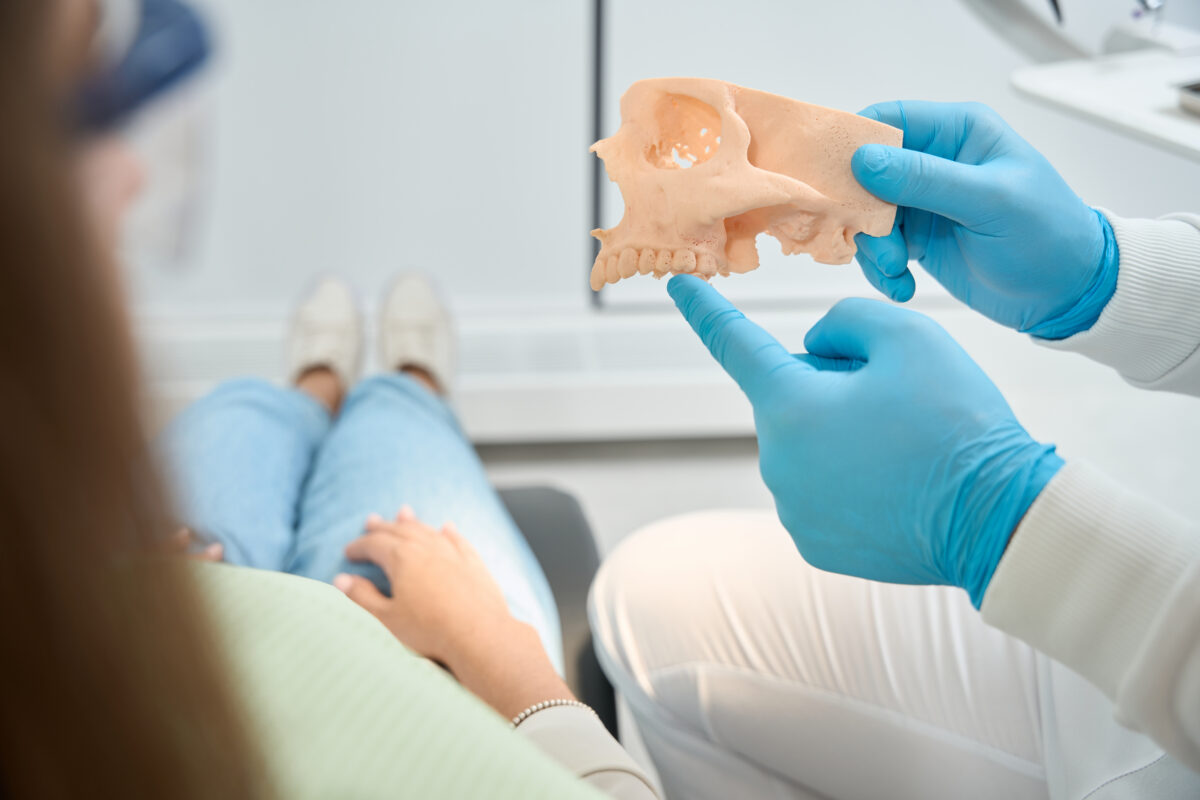
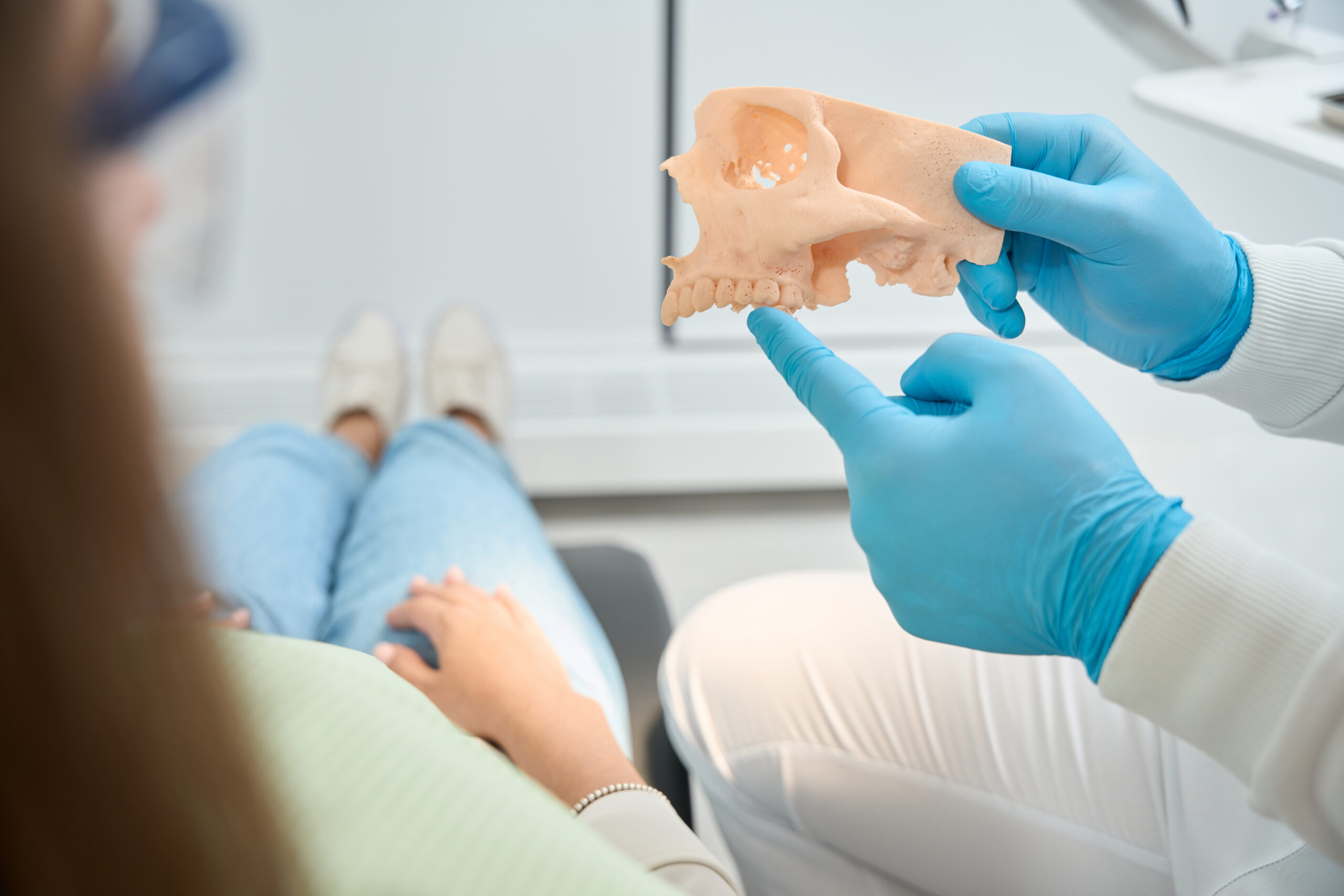
Cropped photo of stomatologist pointing at porous anterior teeth on maxilla model to client

Losing teeth triggers a cascade of changes beneath the surface that many patients never anticipate, as jawbone tissue begins deteriorating in ways that accelerate facial aging and complicate future tooth replacement options. Understanding how bone loss progresses and which restoration approaches effectively prevent further deterioration becomes critical for patients evaluating their options for permanent tooth replacement.

At Atlas Dental Specialists, Drs. Nicholas and Mara Mangini help patients throughout Pittsburgh, Pennsylvania, understand the relationship between tooth loss, bone preservation, and all-on-four implant solutions. Our prosthodontists combine advanced 3D imaging technology with over 25 years of experience to assess bone quality and develop treatment plans that preserve jawbone structure. As a full-service provider handling implant placement and final prosthetics in one location, we create comprehensive solutions that address both immediate restoration needs and long-term bone health.

Why Jawbone Deteriorates After Tooth Loss

The connection between missing teeth and bone loss remains unclear to many patients until they begin evaluating replacement options. “We explain that jawbone is living tissue that needs stimulation,” notes Dr. Nicholas Mangini. “When teeth are lost, that stimulation disappears, and the bone begins to shrink. Dental implants act like artificial tooth roots, helping preserve the bone and maintain facial structure.” This biological process explains why waiting too long after tooth loss can complicate future restoration efforts.

The Timeline of Bone Deterioration

Bone loss does not wait for patients to decide on treatment, beginning almost immediately after tooth extraction and continuing progressively over time. “Bone loss can begin soon after tooth extraction and continues gradually over time,” explains Dr. Nicholas Mangini. “The earlier we intervene with implant solutions, the more bone we’re often able to preserve.” This timeline creates urgency for patients considering permanent tooth replacement, as delaying treatment allows more bone deterioration to occur.

Research published in the Journal of Dental Research by the National Institutes of Health demonstrates that dental implant prevalence has increased substantially over recent decades, with the largest growth occurring among adults aged 65 to 74, reflecting growing awareness of the importance of preserving jawbone structure through implant-based solutions.

When Bone Loss Complicates All-on-X Placement

Advanced bone deterioration does not automatically eliminate candidacy for all-on-x, but it does require additional planning and potentially supplementary procedures. “If bone loss is significant, additional procedures like bone grafting may be needed to create a stable foundation,” explains Dr. Nicholas Mangini. “Advanced imaging allows us to identify this early and plan the safest, most effective approach.” Modern 3D imaging technology enables precise assessment of bone quality and quantity, allowing our team to determine whether immediate implant placement remains feasible or whether preparatory grafting procedures will optimize long-term success.

The Reality of Bone Grafting Requirements

The need for bone grafting varies significantly based on individual bone quality, location of missing teeth, and time elapsed since tooth loss. “There isn’t a single number that applies to everyone,” notes Dr. Nicholas Mangini regarding grafting requirements. “Many patients can avoid grafting due to modern all-on-x techniques, but when grafting is necessary, it can extend the timeline and investment while improving long-term outcomes.” The strategic angled placement of implants in all-on-x procedures often maximizes the use of existing bone, reducing grafting needs compared to traditional approaches.

Comparing Bone Preservation Between Restoration Options

Patients evaluating different full arch restoration approaches often wonder which option provides superior bone preservation over time. “Both options help preserve bone because both rely on implants,” explains Dr. Nicholas Mangini when comparing all-on-x to implant-supported dentures. “All-on-x typically uses more implants and distributes bite forces across the jaw differently, which can be advantageous for long-term stability in certain patients.”

How Implants Prevent Further Bone Loss

The mechanism by which implants preserve bone involves replicating the stimulation that natural tooth roots provide to surrounding jawbone tissue. When you chew with implant-supported restorations, the force transfers through the implant into the bone, signaling the body to maintain bone density in that area. This biological response prevents the progressive deterioration that occurs with traditional dentures, which rest on the gums without providing direct stimulation to the underlying bone.

The distribution of implants across the jaw also influences long-term preservation outcomes. All-on-x uses multiple strategically positioned implants to distribute chewing forces across the entire arch, while implant-supported dentures typically use fewer implants that support a removable prosthesis. Both approaches effectively prevent further bone loss compared to traditional removable dentures, but the mechanics of force distribution differ in ways that may benefit certain patients more than others, depending on their bone quality and functional requirements.

The Importance of Early Intervention

Timing significantly impacts both treatment complexity and long-term outcomes for patients experiencing tooth loss. Early intervention with dental implants preserves more existing bone, potentially eliminating the need for grafting procedures that add time and expense to treatment. Patients who wait years after losing teeth often require more extensive preparatory procedures to rebuild an adequate bone foundation for stable implant placement.

Advanced 3D imaging technology allows our team to assess current bone status and project future deterioration trajectories, helping patients understand how delaying treatment affects their options. This information empowers informed decision-making about whether to proceed with immediate restoration or whether circumstances justify postponing treatment despite ongoing bone loss.

Schedule Your Bone Assessment at Atlas Dental Specialists

Determining your current bone status and understanding how different restoration approaches preserve jawbone structure requires a comprehensive evaluation using advanced imaging technology. As prosthodontists specializing in advanced tooth replacement solutions, Drs. Nicholas and Mara Mangini provide detailed assessments that clarify your bone preservation options and recommend approaches that optimize both immediate restoration outcomes and long-term facial structure maintenance. Our full-service approach means you receive implant placement and final prosthetics in one location without coordinating care across multiple offices.

Don’t allow continued bone deterioration to complicate your future tooth replacement options or accelerate facial aging. Contact our Pittsburgh office today to schedule a consultation and discover how all-on-x or implant-supported dentures can restore your smile while preserving your jawbone structure for years to come.

Are You a Candidate for All-on-X? Key Factors to Consider

Revolutionize Your Smile with All-On-X Permanent Teeth: Stunning Photos for Adobe Stock

The prospect of replacing an entire arch of failing teeth sounds transformative, yet determining whether you qualify for treatment involves more than simply showing up for a consultation. Age assumptions, bone loss concerns, and medical history complexities create uncertainty that prevents many from discovering whether they truly qualify for permanent tooth replacement.

At Atlas Dental Specialists, Drs. Nicholas and Mara Mangini bring prosthodontic expertise to evaluating patients for all-on-four and full arch restoration solutions throughout Pittsburgh, Pennsylvania. Our family-owned practice has served the area for over 25 years, providing comprehensive assessments using advanced 3D imaging technology. As full-service providers who handle implant placement and final prosthetics in one location, we eliminate the need to coordinate care across multiple specialists or dental offices.

What the Evaluation Process Actually Examines

Determining suitability for all-on-x requires examining factors that extend well beyond your current dental condition. “When we evaluate a patient for all-on-x, we’re looking at the full picture—not just their teeth,” explains Dr. Nicholas Mangini. “We assess overall health, jawbone quality, functional goals, and whether the patient truly wants a fixed, long-term solution.” Advanced 3D imaging allows precise planning to determine whether all-on-x can be performed safely and predictably for each individual patient.

Medical Stability Matters More Than Age

Many potential candidates hesitate because they assume their age automatically disqualifies them from consideration. “One of the biggest misconceptions is that age alone disqualifies someone,” Dr. Nicholas Mangini clarifies. “In reality, medical stability is far more important than age.” What truly determines success includes medical stability, oral hygiene practices, and commitment to long-term care. The most common reasons for delaying or modifying treatment relate to controllable health factors rather than chronological age.

Research published in the Journal of Dental Research by the National Institutes of Health found that the largest absolute increase in dental implant prevalence occurred among individuals aged 65 to 74, demonstrating that older adults successfully receive implant treatment when medically stable.

Addressing Bone Loss Misconceptions

Another frequent concern involves patients who believe insufficient bone automatically eliminates their candidacy. “Another common myth is that bone loss means implants aren’t possible,” notes Dr. Nicholas Mangini. “All-on-x techniques often allow us to use existing bone without grafting.” The strategically angled placement of implants maximizes contact with available bone structure, frequently eliminating the need for additional grafting procedures.

Understanding That Candidacy Changes With Preparation

The question of whether you qualify does not always produce immediate yes or no answers. “Candidacy doesn’t fit neatly into a percentage,” explains Dr. Nicholas Mangini. “Many patients become excellent candidates once certain risk factors—like uncontrolled medical conditions or smoking—are addressed.” The most common reasons for delaying or modifying treatment involve health-related factors that patients can often improve with proper commitment and medical management.

Dr. Nicholas Mangini also addresses a fundamental misunderstanding about what all-on-x actually provides. “All-on-x is not ‘just a denture’; it’s a fixed prosthesis designed to function much more like natural teeth.” This distinction matters significantly when evaluating whether the treatment aligns with your goals and expectations for restoration.

Alternative Solutions When All-on-X Requires Delay

For patients who are not immediately ideal candidates, alternative options provide meaningful improvements over traditional removable dentures. Several pathways exist depending on your specific situation:

  • Implant-supported dentures: These provide significantly more stability than traditional dentures while remaining removable for cleaning, offering an excellent middle ground solution.
  • Staged grafting: This approach prepares the jaw for future implant placement, allowing you to pursue all-on-x treatment once bone quality improves to support permanent fixtures.
  • Modified treatment timelines: These address controllable risk factors first, transforming initially unsuitable candidates into excellent candidates through medical management and lifestyle modifications.

These alternatives ensure that you have multiple pathways toward improved oral function and confidence, even when immediate all-on-x placement requires preparation or modification.

Schedule Your Candidacy Assessment at Atlas Dental Specialists

Determining whether all-on-x represents the right solution for your situation requires a personalized evaluation examining your unique health status, functional goals, and circumstances. As prosthodontists trained in advanced tooth replacement techniques, Drs. Nicholas and Mara Mangini combine 3D imaging technology with specialized expertise to develop treatment plans tailored to your specific needs. Our full-service approach means you receive implant placement and final prosthetics in one location without coordinating care across multiple offices.

Don’t let assumptions about age, bone loss, or medical history prevent you from exploring your options for permanent tooth replacement. Contact our Pittsburgh office today to schedule a comprehensive consultation and discover whether all-on-x can help you achieve the stable, functional smile you deserve.

The Cost-Benefit Analysis of Implant-Supported Dentures and All-on-X

render of mandibular prosthesis all on 4 system supported by implants over white background

Choosing between implant-supported dentures and all-on-x involves more than comparing price tags, yet many patients struggle to understand what drives the cost difference and whether the additional investment delivers proportional value. Financial considerations matter, but making decisions based solely on initial expense often overlooks factors that significantly impact long-term satisfaction and function.

At Atlas Dental Specialists, Drs. Nicholas and Mara Mangini help patients throughout Pittsburgh, Pennsylvania, navigate the decision between implant-supported dentures and fixed full arch solutions. Our prosthodontists combine over 25 years of experience with advanced technology to provide comprehensive evaluations that examine both immediate costs and long-term value. As a full-service provider handling implant placement and final prosthetics in one location, we guide patients toward solutions that align with their functional goals, lifestyle preferences, and financial situations.

Understanding the Investment Difference

The financial gap between implant-supported dentures and all-on-four reflects fundamental differences in treatment complexity and outcomes. “All-on-x is a more comprehensive, fixed solution, so it represents a higher investment than implant-supported dentures,” explains Dr. Nicholas Mangini. “The difference reflects the number of implants used, the complexity of the procedure, and the fabrication of a fixed prosthesis rather than a removable one.”

What Drives the Cost Variation

All-on-x typically requires more implants strategically placed to support a permanently fixed prosthesis, while implant-supported dentures function with fewer implants supporting a removable appliance. The fabrication process for fixed prosthetics involves additional complexity in design, materials, and precision compared to removable alternatives.

Surgical complexity also differs significantly between these approaches. All-on-x requires more extensive planning and execution to ensure proper integration and support for permanent restoration, contributing to the higher investment required for this comprehensive solution.

Factors Beyond Price That Drive Treatment Decisions

Financial considerations represent just one component of the decision-making process for patients evaluating full arch restoration options. “Beyond cost, the biggest deciding factor is whether a patient wants fixed or removable teeth,” notes Dr. Nicholas Mangini. “Lifestyle, hygiene preferences, and functional expectations—like chewing confidence and speech—play a major role in that decision.”

Research published in the Journal of Dental Research by the National Institutes of Health demonstrates that dental implant prevalence has increased substantially, with the largest growth occurring among adults aged 65 to 74, reflecting the value patients place on permanent tooth replacement solutions.

How Lifestyle and Function Influence Value

The choice between fixed and removable restoration significantly impacts daily life in ways that extend beyond the initial financial investment. Patients who prioritize maximum stability during eating and speaking often find that all-on-x provides confidence that justifies the additional cost.

Conversely, patients who value the ability to remove their prosthesis for thorough cleaning may find that implant-supported dentures better align with their hygiene preferences and comfort level. Lifestyle factors such as travel frequency, manual dexterity, and daily routine flexibility also influence which option delivers greater practical value.

Comparing Long-Term Maintenance Requirements

Evaluating true cost-benefit ratios requires examining maintenance needs and expenses over the lifespan of each treatment option. “Both options require maintenance, just in different ways,” explains Dr. Nicholas Mangini. “All-on-x prosthetics are very durable but will eventually need service or replacement, while implant-supported dentures require periodic attachment maintenance.”

The Reality of Ongoing Care

All-on-x prosthetics demonstrate impressive durability but typically require professional servicing or complete replacement after years of function. Implant-supported dentures need periodic adjustment of attachment components as natural wear occurs over time.

Both options benefit from regular professional cleanings and evaluations to ensure implant health and optimal function. Dr. Nicholas Mangini emphasizes that “long-term success depends on ongoing professional care” regardless of which restoration approach patients choose.

Making Treatment Accessible Through Flexible Financing

Cost concerns should not automatically eliminate consideration of either treatment approach without exploring available financial solutions. “We offer flexible financing options, including third-party financing and in-house payment plans, to help patients choose the solution that best fits their goals rather than feeling limited by cost alone,” notes Dr. Nicholas Mangini. Several options exist to make both approaches accessible to patients committed to full arch restoration:

  • Third-party financing: Specialized healthcare financing companies provide payment plans with various terms and interest rates, allowing patients to spread costs over manageable monthly payments.
  • In-house payment plans: Our practice offers direct payment arrangements that provide flexibility without involving external financing companies, creating accessible pathways for patients committed to treatment.
  • Insurance coordination: While dental insurance typically provides limited coverage for implant procedures, our team maximizes available benefits to reduce out-of-pocket expenses wherever possible.

These financial pathways ensure that treatment decisions prioritize long-term satisfaction and function rather than short-term budget constraints.

Considering Future Treatment Modifications

Some patients wonder whether choosing implant-supported dentures initially limits future options or requires starting over if preferences change. “It does happen, usually when patients decide they want the convenience and feel of fixed teeth,” explains Dr. Nicholas Mangini regarding upgrades from implant-supported dentures to all-on-x.

“However, many patients are very satisfied long-term with implant-supported dentures when that option aligns with their lifestyle.” This flexibility means that selecting the more conservative option initially does not eliminate the possibility of transitioning to fixed restoration if circumstances or preferences evolve over time.

Schedule Your Consultation at Atlas Dental Specialists

Determining which full arch restoration approach delivers the best cost-benefit ratio for your specific situation requires a comprehensive evaluation examining your functional needs, lifestyle preferences, and financial considerations. As prosthodontists specializing in advanced tooth replacement solutions, Drs. Nicholas and Mara Mangini provide detailed assessments that clarify the practical and financial implications of both options. Our full-service approach means you receive implant placement and final prosthetics in one location, eliminating the complexity of coordinating care across multiple offices.

Don’t make decisions about full arch restoration based on incomplete information about costs, benefits, and long-term value. Contact our Pittsburgh office today to schedule a consultation and discover which solution delivers the optimal combination of function, satisfaction, and financial accessibility for your unique circumstances.

Implant-Supported Dentures for Active Seniors: Maintaining Your Lifestyle

Happy active senior couple outdoors

Staying active as you age shouldn’t mean worrying about your teeth slipping or shifting during your favorite activities. Implant-supported dentures offer a permanent solution that lets you focus on what matters most, whether you’re playing golf, hiking, or simply enjoying meals with family and friends.

At Atlas Dental Specialists, we help active seniors restore both function and confidence with secure, natural-feeling tooth replacement options. Dr. Nicholas Mangini and Dr. Mara Mangini work with patients throughout Pittsburgh to design custom implant-supported dentures that fit seamlessly into your active lifestyle.

What Makes Implant-Supported Dentures Different

Traditional removable dentures rest on your gums and rely on adhesives or suction to stay in place. Implant-supported dentures attach to dental implants surgically placed in your jawbone, creating a stable foundation that mimics natural tooth roots.

This design offers several advantages. The implants fuse with your bone through a process called osseointegration, providing strength comparable to natural teeth. You can eat foods that might be difficult with traditional dentures, and you don’t need to remove your dentures for cleaning each night.

How the Treatment Works

The process typically occurs in stages. First, titanium implants are placed in strategic positions along your jaw. After a healing period of several months, custom dentures are attached to these implants using special connectors.

Some patients can receive their implants and temporary dentures on the same day, while others may benefit from a more gradual approach. Your treatment timeline depends on factors like bone density, overall health, and the number of implants needed.

Benefits for Active Lifestyles

Implant-supported dentures eliminate many concerns that limit seniors with traditional dentures. You can speak clearly without worrying about dentures slipping during conversation. Physical activities become easier when you’re not concerned about dentures shifting position.

The stability also supports better nutrition. You can bite into apples, enjoy steaks, and eat corn on the cob without hesitation. This improved diet can contribute to better overall health and energy levels.

Bone preservation is another vital benefit. Natural teeth and implants both stimulate your jawbone through chewing forces. The American Dental Association notes that implants help maintain bone structure in ways that traditional dentures cannot, potentially slowing the facial changes that sometimes occur after tooth loss.

Types of Implant-Supported Dentures

Two main options exist for implant-supported dentures. Fixed dentures attach permanently to your implants and can only be removed by your dentist during checkups. These function most like natural teeth and typically require four to six implants per arch.

Removable implant-supported dentures snap onto two to four implants but can be taken out for cleaning. This option costs less than fixed dentures while still providing more stability than traditional removable dentures.

Your choice depends on several factors:

  • Lifestyle preferences: Fixed dentures eliminate the need for nightly removal but require professional cleaning. Removable options offer easier at-home maintenance.
  • Bone density: Patients with significant bone loss may need bone grafting to support fixed dentures, while removable options sometimes work with fewer implants.
  • Budget considerations: Removable implant dentures typically cost less upfront and may fit better with insurance coverage or payment plans.
  • Maintenance comfort: Some patients prefer cleaning dentures outside their mouth, while others appreciate the convenience of permanent restoration.

Each option offers substantial improvements over traditional dentures in terms of stability and comfort.

Maintaining Your Implant-Supported Dentures

Daily care for implant-supported dentures resembles caring for natural teeth. Brush twice daily with a soft-bristled toothbrush, paying attention to where the dentures meet your gums. Use an antimicrobial mouth rinse to reduce bacteria around the implant sites.

Regular dental visits remain important. Professional cleanings remove buildup from hard-to-reach areas and allow your dentist to check implant stability. Most patients need checkups every six months, though some may benefit from more frequent visits during the first year.

Avoid habits that could damage your restoration. Don’t chew on hard objects like ice or pen caps. If you play contact sports, wear a mouthguard designed for implant-supported dentures.

Restore Your Active Lifestyle With Atlas Dental Specialists

Implant-supported dentures can help you maintain the active, fulfilling lifestyle you’ve worked hard to build. The stability and functionality they provide may open doors to activities and foods you’ve avoided with traditional dentures. At Atlas Dental Specialists, we bring together the skills of both general and specialty dentistry to create tooth replacement solutions tailored to your needs.

Our team uses advanced imaging and planning techniques to design your treatment for optimal results. We also offer flexible financing options to make this investment in your quality of life more accessible. If you’re ready to explore implant-supported dentures, contact our team to schedule a consultation at our Shadyside or Downtown Pittsburgh location.

Eating with Confidence: How All-on-X Improves Function

Beautiful young african woman eating fresh salad with cherry tomatoes. Portrait of happy smiling woman in diet isolated on blue background. Cheerful brazilian girl with curly hair eating fresh vegetable while looking at camera with copy space.

All-on-x treatment replaces a full arch of missing or failing teeth with a permanent prosthetic anchored by just four to six dental implants. This approach restores your ability to bite into firm foods, chew comfortably, and eat without restrictions that traditional dentures impose. You can stop cutting your food into tiny pieces and avoiding restaurants. All-on-x gives you back the confidence to eat what you want, when you want.

At Atlas Dental Specialists, our prosthodontists provide all-on-x solutions for patients throughout downtown Pittsburgh and Shadyside who want to regain full dental function.

Why Traditional Dentures Limit Your Diet

Traditional dentures sit on your gums and rely on suction or adhesives to stay in place. This creates multiple problems when you try to eat. The dentures shift and move as you chew, making it hard to apply proper biting force. You end up avoiding crunchy vegetables, chewy meats, and sticky foods because they either dislodge your dentures or get stuck underneath them.

The lack of stability also means you can’t generate the same chewing power you had with natural teeth. Studies show traditional denture wearers retain only about 20% of their original biting force. This limitation forces you to change your diet, often leading to poor nutrition and avoiding social meals.

How All-on-X Restores Full Chewing Function

Full mouth reconstruction with all-on-x creates a fixed prosthetic permanently attached to dental implants in your jawbone. The implants act as artificial tooth roots, transferring chewing forces directly into the bone just like natural teeth. This gives you approximately 80% of your original bite strength back.

The prosthetic doesn’t move when you eat. You can bite down firmly on an apple, tear into a steak, or crunch through raw vegetables without worry. The stability comes from strategically placing four to six implants per arch at angles to maximize support and evenly distribute pressure across your jaw.

Foods You Can Eat Again

All-on-x opens up your diet in ways traditional dentures never could. You regain the ability to enjoy meals without constant anxiety about your teeth.

  • Crunchy foods: Raw carrots, apples, nuts, and crispy salads become manageable again without fear of denture damage or slippage.
  • Chewy proteins: Steak, chicken, pork chops, and other meats you can bite and chew normally instead of cutting into small pieces.
  • Sticky foods: Caramel, peanut butter, and chewy bread no longer pose a threat to your denture stability or comfort.

These improvements occur because your new teeth are locked in place and can withstand the same forces that natural teeth do.

The Treatment Process

The process begins with a consultation, during which your prosthodontist examines your jaw and takes 3D scans. These images show bone density and aid in planning implant placement. If your bone has deteriorated, you may need a bone graft before the procedure.

Surgery typically happens in one appointment under sedation. Your dentist places four to six implants per arch at precise angles to maximize support. In many cases, you receive a temporary prosthetic the same day, so you never go without teeth. This immediate-loading approach lets you eat soft foods right away while your implants heal and fuse to the bone over three to six months. Once healing is complete, your final prosthetic attaches to the implants, restoring full chewing function.

Long-Term Benefits Beyond Eating

The benefits extend beyond just being able to eat normally again. All-on-x prevents the bone loss that traditional dentures cause. When implants transfer chewing forces into your jawbone, the bone stays stimulated and maintains its density. This preserves your facial structure and prevents the sunken appearance many denture wearers develop.

Maintenance is straightforward. You brush twice daily and floss around the implants, just like you do with natural teeth. Regular dental checkups every six months help keep everything healthy. The prosthetic typically lasts 10 to 15 years before needing replacement, while the implants themselves can last a lifetime with proper care.

Regain Your Eating Confidence at Atlas Dental Specialists

If missing or failing teeth are preventing you from enjoying meals and limiting your diet, all-on-x offers a permanent solution. Our team provides full-service dental implant care, handling both the implant placement and prosthetic creation in one location. As prosthodontists with advanced training in dental implants and implant prosthetics, we focus on complex cases such as full arch replacement. Named after the mighty Atlas statues outside our windows, our family-owned practice has served downtown Pittsburgh for over 25 years.

Ready to eat with confidence again? Contact Atlas Dental Specialists today to schedule a consultation at our downtown Pittsburgh or Shadyside location.